Lessons learned from making art
Posted onMy resolution for 2025 was to make more art. I had a lot of fun keeping it. I took acrylic painting lessons, got into watercolours, printed stickers, organised art meet-ups and made hundreds of sketches and paintings.
Along the way, I have learned a few lessons that apply beyond the canvas.
Make mistakes
I became a better artist when I allowed myself to make mistakes.
Until recently, I used the pages of my notebooks parsimoniously. I feared disgracing them with subpar work. Real artists only produce Good Art! What if someone flipped through my notebook and exposed me as a fraud?
Then I took a painting class, and we spent the first two hours making lines and splotches. We used different paintbrushes, then paper towels, business cards and our fingers. When we made anything recognizable, the teacher would swipe his thumb across it to ruin it. The goal was to study how acrylic paint feels, not to make something beautiful. I learned more by wasting paint for two hours than by rationing it for decades.
This got me to experiment more. A lot more. I have learned to slip up, cock up, blunder and bumble as a matter of course. Paper is cheap. Mistakes are part of the creative process. Failing means trying, and trying means learning and improving.
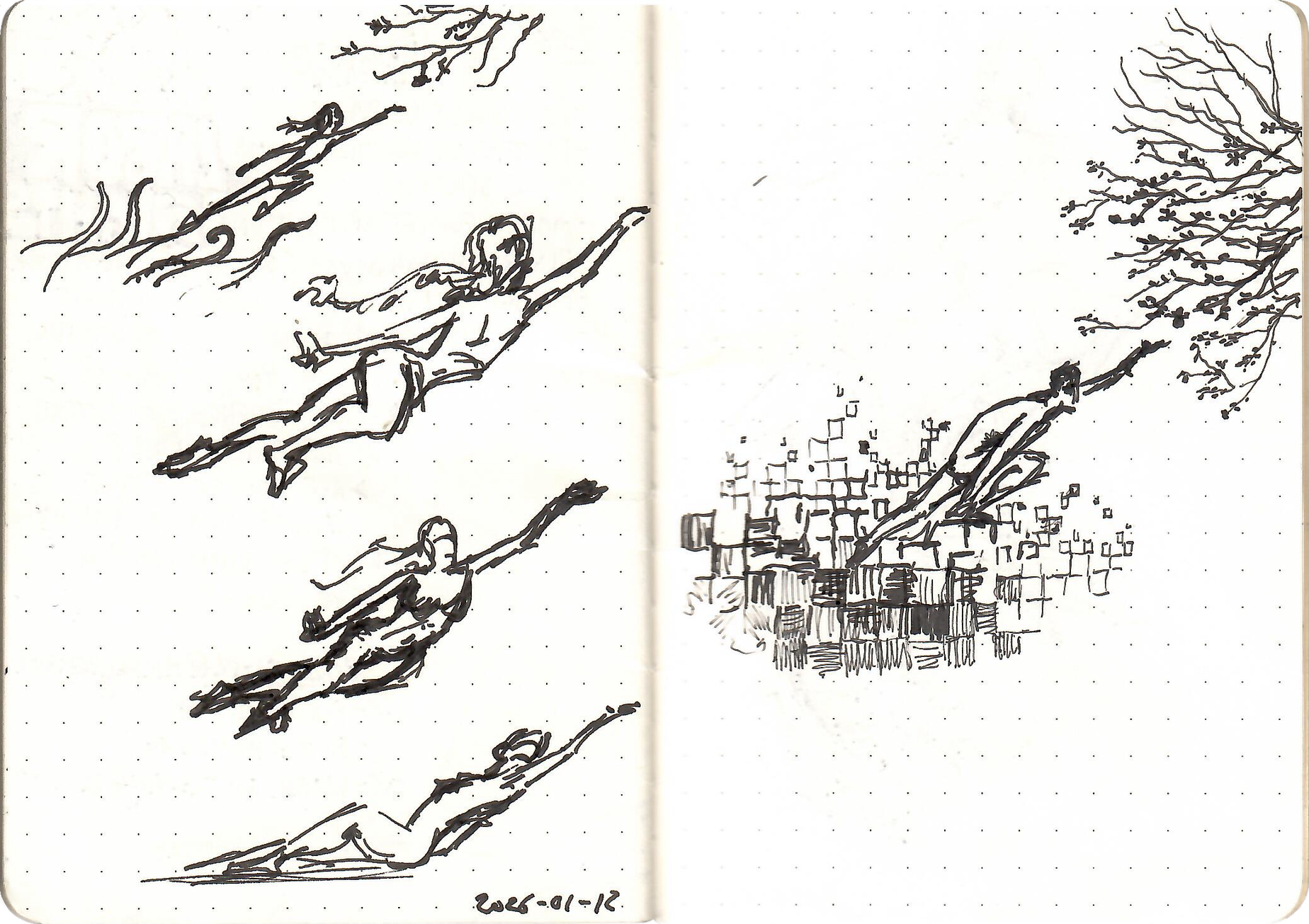
And boy did I improve! This change in perspective made me less risk-averse. It made me try new techniques and tackle bolder subjects. It made me practice more, and my skills have developed at a staggering pace.
I have applied this lesson beyond the canvas. I had a culinary breakthrough by cooking a series of bad curries. I fell on my ass more than ever, but became a better ice skater. Now I am trying to accept rejection and awkward conversations as the cost of meeting interesting strangers.
“Sucking at something is the first step towards being sorta good at something.”
— Jake the dog
You are your own harshest critic
When I got into watercolours, I made a portrait of a friend that now hangs in his office. He even framed it.
When I made stickers of one of my doodles, they started showing up on my friends’ water bottles. I thought they were just obliging me, but then their friends asked for stickers.
We tend to compare ourselves to the very best in our field. Sometimes it’s good to appreciate how far along you have come, and not just how far from the summit you still are.
Hyperopia
I tend to get stuck on getting tiny details perfectly right while losing sight of the big picture. This often produces highly detailed turds. I quite literally miss the forest for the trees. It’s a form of hyperopia, in which problems can be seen clearly at a distance, but are blurry up close.
Our painting teacher frequently made us take a few steps back from the canvas. The distance helps you notice structural flaws in your work.
I have learned to get the broad strokes right before sweating the small stuff. If a drawing feels off, I allow space and time to highlight mistakes that I’m too close to the canvas to see.
Do the thing
Above all, do the thing. If you fancy yourself an artist, make art. A painter paints. Buying fancy brushes is not painting. Going to art museums is not painting. Following creators is not painting.
For me, doing the thing meant carrying a sketchbook around and using it. It meant making a space for art in my apartment and in my calendar. I did end up buying better pens and better paint, but that came later, when I knew how to use them.
I used to draw on lined paper with a mechanical pencil. It was good enough for all of my childhood. I try to remember that when I fuss about pigment and paper quality. If anything, cheap art supplies encourage you to waste them and experiment more.
Art is about the choices we make
Making things myself has changed the way I appreciate other people’s work. I used to understand the word “appreciate” as establishing the value of something. I thought that appreciating a Van Gogh painting meant seeing why Starry Night is so damn popular, because if you don’t, something is just wrong with you.
Only since recently do I understand appreciation in the sense of love and gratitude. Failing to paint one landscape after another make me appreciate just how difficult it is to convey emotion in just a few brush strokes.
Painting is not about faithfully reproducing what the eyes see. The invention of photography has greatly devalued this aptitude. Making art is all about making choices. You can’t draw every single leaf of a tree, so you have to take shortcuts. The shortcuts that you choose to take is the message your are making.
This applies to other areas of your life. Life is unfathomably complex and your time on Earth is a blip. You are the shortcuts you take and the parts you choose to highlight.