Notes
Digital clippings I might Whatsapp you.-
“Out of the crooked timber of humanity, no straight thing was ever made”
— Immanuel Kant
-
Below, some articles I have enjoyed since my last link dump.
Technology:
- Our internet by Spencer Chang
- Rage, rage against the machine by Jason Kenny
Life:
- The Fear of Dying Before You Become Yourself, which many of my friends also loved
- The virtues of summer by Tomás Aguillar
- It’s very weird to have a head full of poison by Adam Mastroianni
- On the urgency of leisure by Tomás Aguillar
- Being creative requires taking risks by Henrik Karlsson
- To feel and to fail by Visakan Veerasamy
- Things I’ve learned about making decisions by Kasra
- Ink in the stomach by Simon Sarris
- Loose fear by Spencer Chang
- Want what you already have by Isabel
- If experience is the goal, then you always win by Nix
Love and friendships:
- Get caught staring and the rest of how to be approachable on Less Penguiny
- Making a home of each other by Lucy Bellwood (and look at her gorgeous website!)
- Approaching friendship from a place of security by Kasra
Interesting:
- A Big Little Idea Called Legibility on Ribbonfarm
- L’Affaire Siloxane by Maciej Cegłowski
- Bitter Lessons from the ISSpresso by Maciej Cegłowski
- Bourdieu’s theory of taste: a grumbling abrégé by Dynomight
-
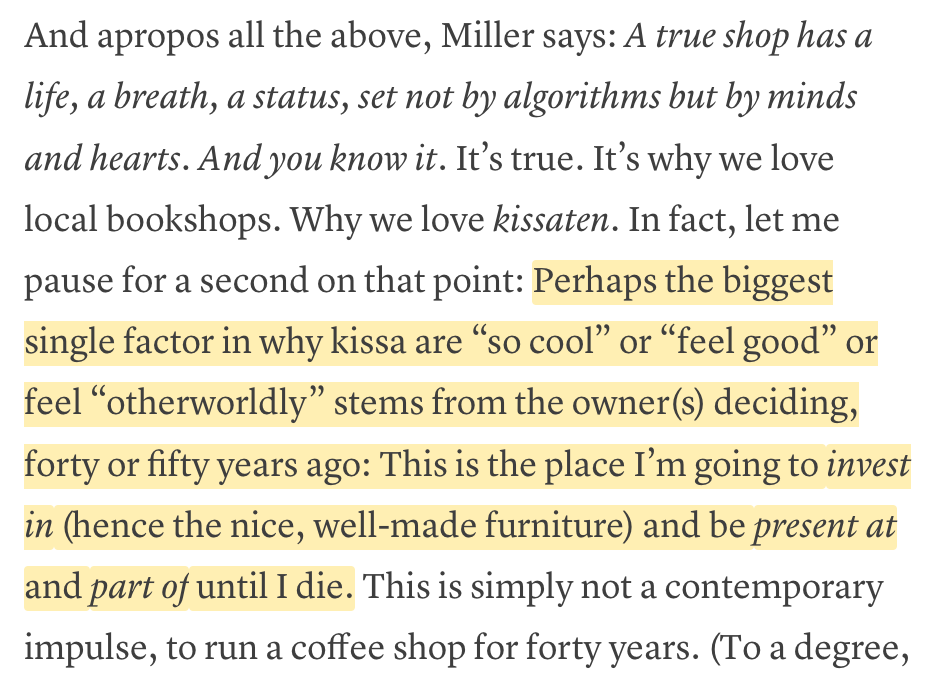
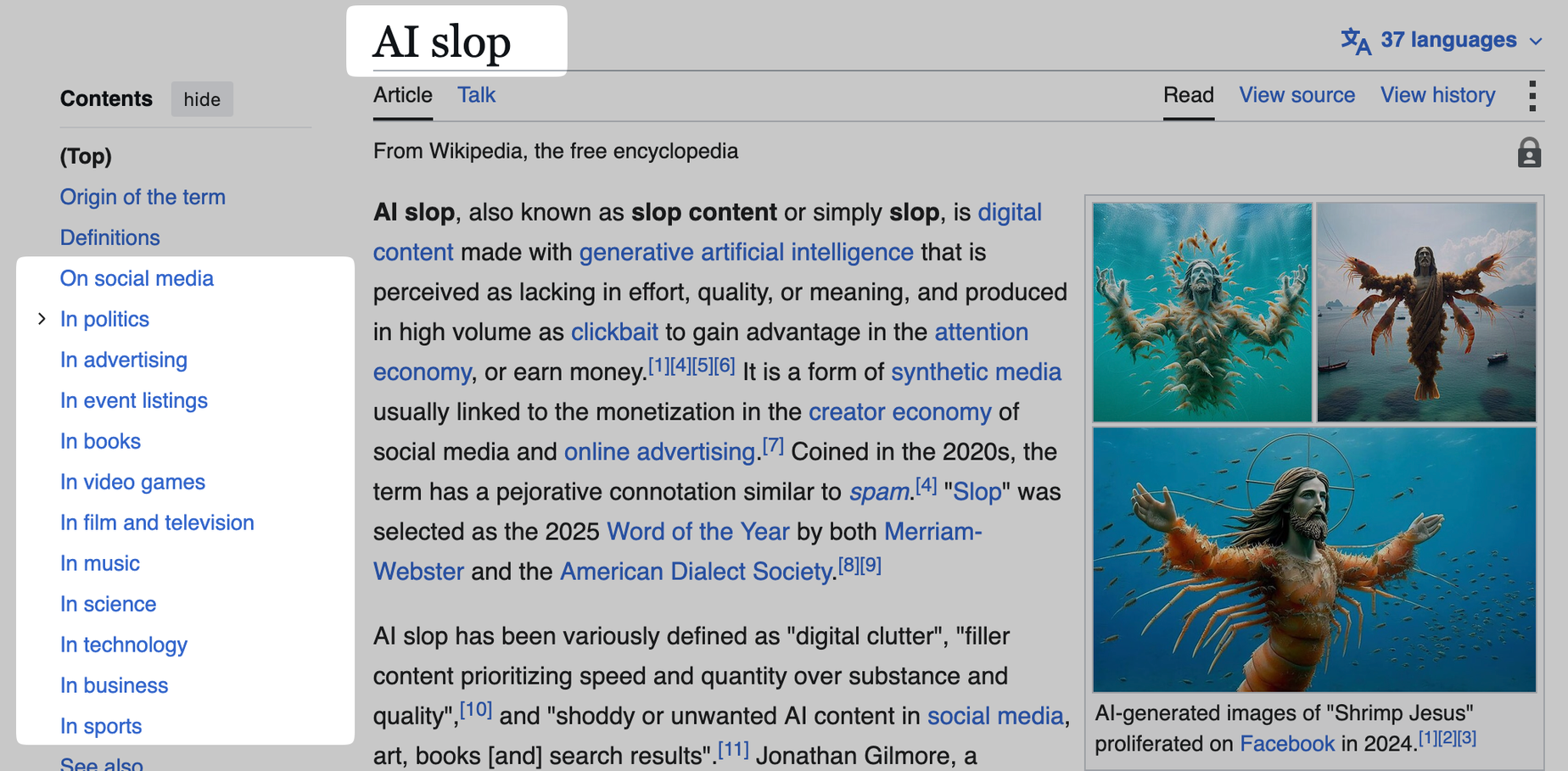
It’s the first time my feelings get validated by a table of contents.
-
“I don’t know about you, [but] I’m gonna have to leave the planet. ‘Cause the technology is just gonna get better and better and better and better. And it’s gonna get easier and easier, and more and more convenient, and more and more pleasurable to be alone with images on a screen, given to us by people who do not love us but want our money. Which is all right. In low doses, right? But if that’s the basic main staple of your diet, you’re gonna die. In a meaningful way, you’re going to die.”
—David Foster Wallace, in freaking 1996
-
“One can waste a life without ever doing anything obviously wrong. But waste it in the continuous habit of deferring the enjoyment, the experience, to a nearby future, which will begin shortly, under better conditions, when one is more prepared.”
—Tomás Aguillar, On the Virtues of Summer
-
I am getting more and more AI-generated outreach emails. They look legit at first glance, but all follow the exact same pattern: a specific compliment, an intro, a pitch, and an apology for bothering you. A week later, a follow-up email. And of course, the usual LLMisms.
Invariably, the author’s LinkedIn confirms that they have no industry experience, and vibe-coded the whole thing a month ago.
I am used to spam. I don’t feel strongly about the dozens of spam emails I get every day. However, it feels extra wrong to me that someone asked a computer to flatter me and build rapport. It poisons the well for every genuine person who wants to connect with strangers over the internet.
-
I was interviewed for an NPR podcast episode. It explains how Google AI summaries strangle the web. There are a few sound bites about how AI is killing All About Berlin.
-
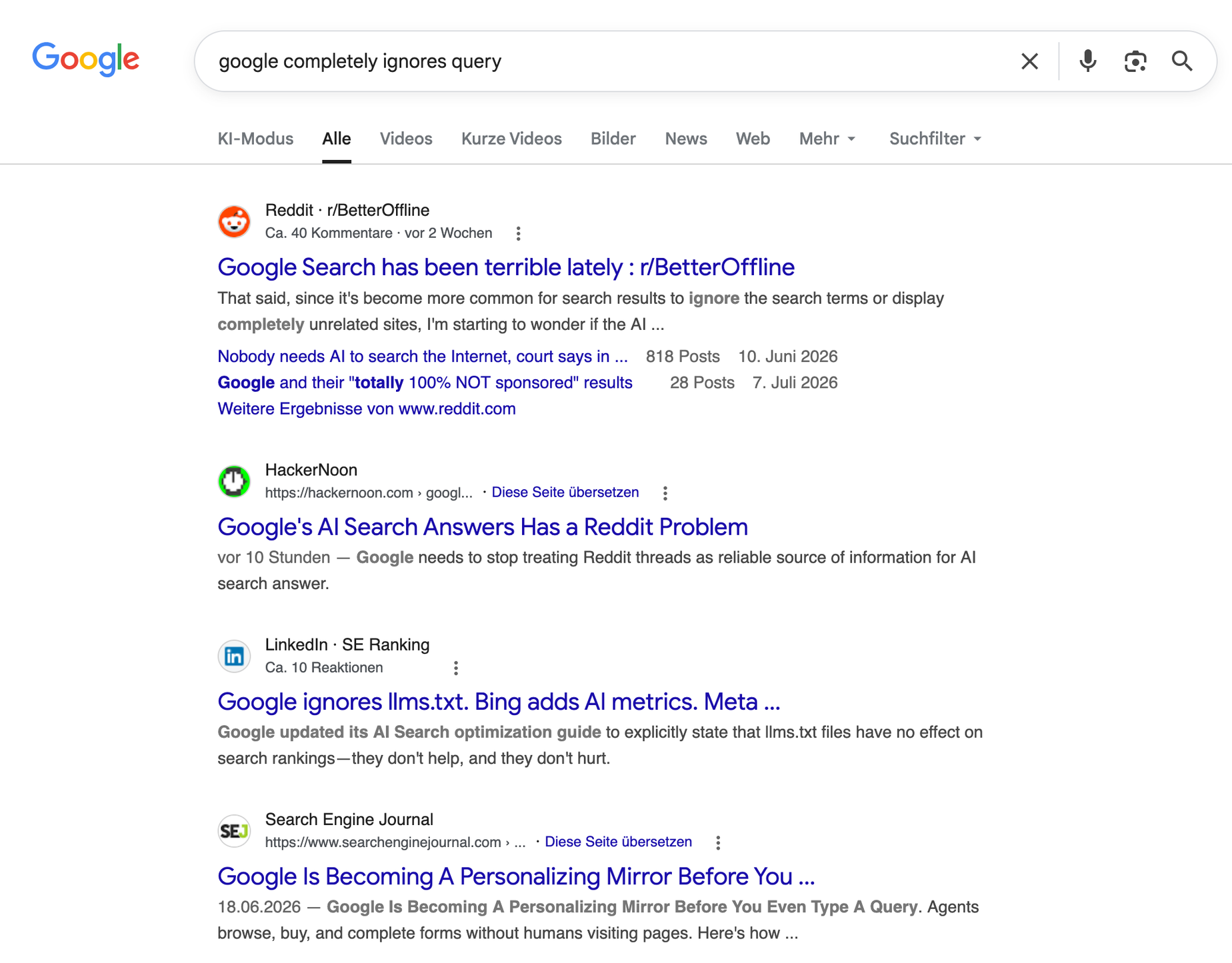
I know that the quality of Google Search results are in a years-long decline, but now it downright ignores my search queries.
-
“We overestimate what we can do in a day and underestimate what we can do in ten years.”
—Bill Gates, paraphrased
-
Berlin is lovely in May. I finally get to sit on my balcony all day, and it makes the events seem so much more palatable. My umbrella flaps gently in the breeze. Blackbird whistles and robin chirps. Clanking plates and chatting neighbours a few stories below. It’s nice to be here.
Books:
- Grapes of Wrath, especially chapter 5. Still my favourite book.
People:
- Communities are not fungible
- Looking for Alice
- The world reveals itself to those who travel by foot
- Talking to 35 strangers at the gym
- Five geek social fallacies and the missing stair
- What cowboys know about love
History:
- Maybe there’s a pattern here?
- Collections: Strategic Airpower 101
- You Can Now See the Code That Helped End Apartheid
- Zersetzung
AI (but I swear these are interesting):
Miscellany:
- Metaphors we believe by
- The Intriguing History of the Map Navigation Symbol (and everything else on this blog)
- Underrated ways to change the world, vol. II
- Unhurried ambition
- Think small
- Bored of eating your own dogfood? Try smelling your own farts!
- How One Las Vegas ED Saved Hundreds of Lives After the Worst Mass Shooting in U.S. History
-
AI on All About Berlin? Yes, but not like that.
I am releasing a tool that updates the website when certain facts change. For example, if the minimum wage goes up, it updates the number everywhere on the website. Constant, automated fact-checking.
The best part is that it barely uses AI. A tiny LLM extracts values from text. After that, it’s all boring technology. If a value changes, a constant gets updated in the code, a change request is submitted, and a human has to approve it. There are no unsupervised changes, and all content is still written by a human.
-
I am experimenting with Claude Code for the first time. I am building a tool that monitors certain pages for changes, uses a small LLM to filter them, and takes action based on that. For example, making a push request to All About Berlin when the German minimum wage changes, or sending me a daily digest of discussions about the immigration office on different social media.
So far, it needs a lot of hand-holding to produce acceptable code. The code works, but it’s far from elegant. I have to fix a lot of not-quite-bugs such as logging warnings instead of throwing exceptions.
On the bright side, I just make comments and let it make the changes, and I find that seriously cool. For example, “this method should fail hard and fast; don’t suppress errors”. This lets me focus on what I want, and not on tedious text editing. This already makes Claude worth it for me.
-
Curry tip: wait for the oil to separate.
-
I have just released a guide on leaving Germany.
-
A few things I’ve enjoyed reading recently.
Miscellaneous:
- RMS Carpathia’s rescue of Titanic survivors (hopemaxxing)
- Finding Peter Putnam
- How to Fix a Typewriter and your Life
- The truth behind the 2026 J.P. Morgan Healthcare Conference (humour)
- How I Taught My Neighbor to Keep the Volume Down (humour)
- The Stranding of the MV Shokalskiy
- An Interactive Guide to Ambiguous Grammar (2015)
Life:
- Thank you for being annoying
- How to be less awkward
- The thirteen laws of good luck
- Maybe you’re not actually trying
- Are you stuck in movie logic?
Technology:
-
I write documentation for a living. Although my output is writing, my job is to observe, listen and empathise. That demands the sort of compassion only a human being can feel.
I revise my local public transit guide every time I board a foreign bus. I improve my writing by walking in my readers’ shoes and feeling their confusion. Empathy drives my work.
Most of my information comes from a network of people I have a built relationships with, and from a large and trusting audience. This infrastructure took years to build. AI can only report what someone was bothered to write down, but I actually go out in the real world and ask questions.
I have built tools to collect people’s experience at the immigration office. I have had many conversations with lawyers and other experts. I have interviewed hundreds of my readers. I have put a lot of information on the internet for the first time. AI writing is only as good as the data it feeds on. I hunt for my own data.
People who think that AI can do the work technical writers have an almost insulting understanding of the jobs they are trying to replace.
-
It’s that time of the year where I sit down and seriously think about my resolutions for the next year. I take those seriously.
This time, I think a lot of Swizec’s recent visualisation of a drunkard’s walk. If he takes each step in a random direction, he will never stumble further than the square root of the number of steps.

But if you bias his steps 10% in a given direction, look at him go!

This is how I see new year resolutions, less as an oath, but as a 10% bias in some direction.
-
Some articles I have enjoyed reading recently:
-
Some problems are like getting a diploma: you work at it for a while, and then you’re done forever. Learning how to ride a bike is a classic diploma problem.
But most problems aren’t like that. They’re more like toothbrushing problems: you have to work at them forever until you die. You can’t, as far as I know, just brush your teeth really really well and then let ‘em ride forever.
-
Three concepts I bring up often:
- TV-buying problem: A product category where all options look the same, none of the features make sense, and all of the specs are misleading. You pretty much need an expert to pick for you. Televisions, smartphones and health insurance are such products.
- Ryanair check in experience: A process that involves repeatedly refusing to buy things, give up personal data, or sign up for marketing spam.
- The ‘Ist’ and the ‘Soll’: How things should be on paper, and how they are in reality. It’s the difference between having rights, and being able to effectively enforce them.
-
Everyone is tired. Everyone secretly wants someone else to ring the bell. Host the cheap thing. Name the time and end. Say, “door is soft; leave when you must.” Put crisps in a bowl. Friendship is logistics performed tenderly.
-
If you are an adult, and you have a problem with an organisation, your first steps should be:
- Read the messages you have received from that organisation
- Read the contract you have signed with that organisation
- Contact the organisation’s customer service
- Search the internet for existing answers
- Ask the community
People often go straight for step 5, and I find that disrespectful of other people’s time.
-
When I’m working on an essay, I spend far more time reading than writing. I’ll reread some parts 50 or 100 times, replaying the thoughts in them and asking myself, like someone sanding a piece of wood, does anything catch? Does anything feel wrong? And the easier the essay is to read, the easier it is to notice if something catches.
—Paul Graham, Good Writing
“Sanding” is a great metaphor for the work I do. The same content, revised again and again over many years. This morning, I am revising my health insurance guide once again. I am applying new insights from dozens of reddit threads and hundreds of reader questions. I have found a more straightforward way to explain things, small details I had not mentioned yet.
-
A few of the things I enjoyed reading recently:
- Everything from Prickly Oxheart, but particularly Who are you without the next thing to do?, Do nothing and What if this is it?
- The whispering earring. A prescient cautionary tale.
- Speak White by Michèle Lalonde recently resurfaced in conversation
- When we get Komooted. When a community that you have built sells out to venture capital.
- Everything from Experimental History. It’s hard to pick a favourite after reading a dozen posts back to back.
- The symbol of earthly good, and the immediate object of toil.
-
I have finally started implemented visual regression testing on All About Berlin. It takes screenshots of elements, and compares them to old ones. If anything changed by even one pixel, I get an error. This helps me catch bugs and unexpected visual changes.
Since I already use Pytest and Playwright, I chose to use this library.
-
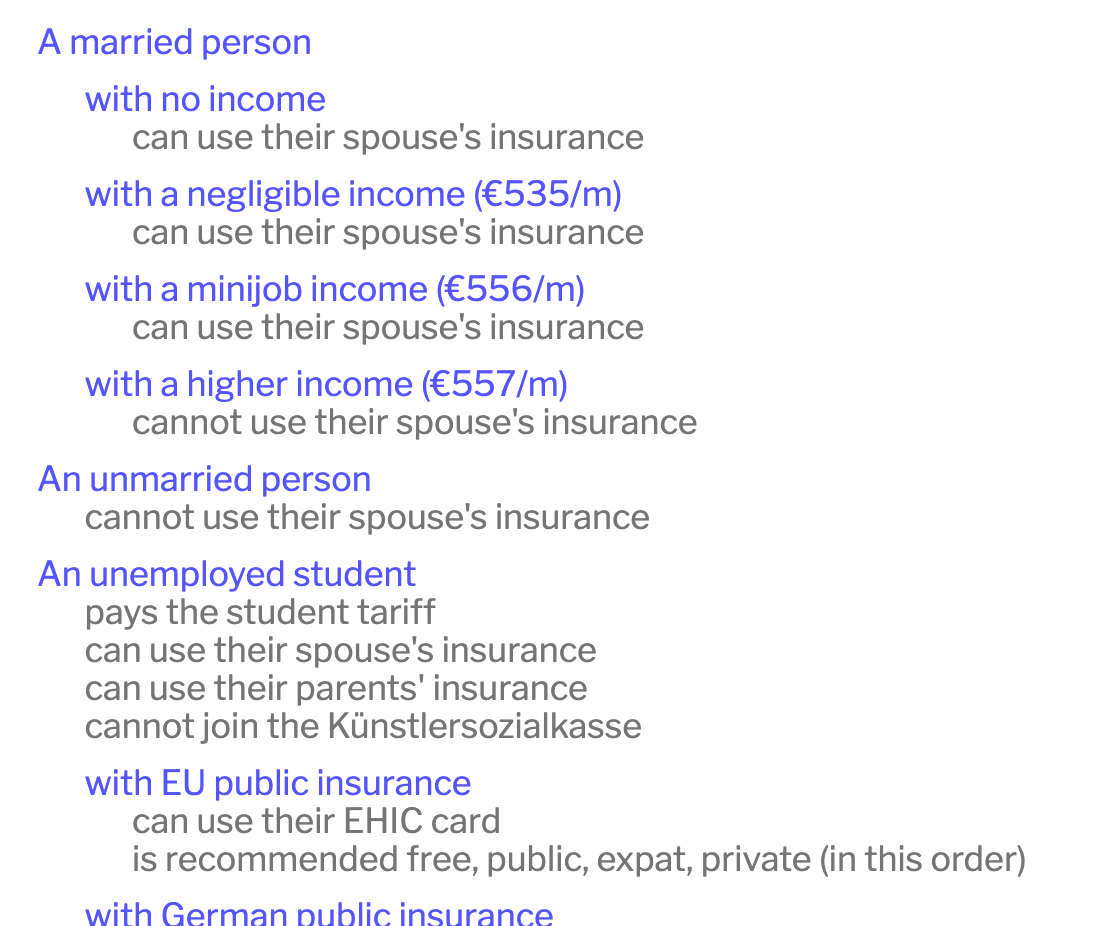
It’s time to bite the bullet and clear some technical debt. All About Berlin has unit tests, but they’re run manually, and some of them are a pain to update. As the website’s tools grow in complexity, manual testing is quickly becoming unsustainable. A change in the health insurance calculator logic might break the tax calculator, and I won’t notice until someone complains.
This cowboy coder has yee’d his last haw, and started rewriting his tests to be easier to understand and easier to update. The goal is to iterate towards a fully automated CI/CD pipeline. Pretty fancy for a blog!
-
“There’s lots of ways to be, as a person. And some people express their deep appreciation in different ways. But one of the ways that I believe people express their appreciation to the rest of humanity is to make something wonderful and put it out there.
And you never meet the people. You never shake their hands. You never hear their story or tell yours. But somehow, in the act of making something with a great deal of care and love, something’s transmitted there. And it’s a way of expressing to the rest of our species our deep appreciation. So we need to be true to who we are and remember what’s really important to us.”
—Steve Jobs, 2007