Making a kukri knife
Posted onToday, I took a kukri-making class with my friend Louis in Kathmandu. A kukri is a knife that’s shaped like a banana. It’s the national weapon of Nepal, and the symbol of its famed Gurkha warriors.

Our guide picked us up at our hotel in a Maruti Alto. It tickles me pink to watch my burly friend squeeze himself into the back of these tiny cars.
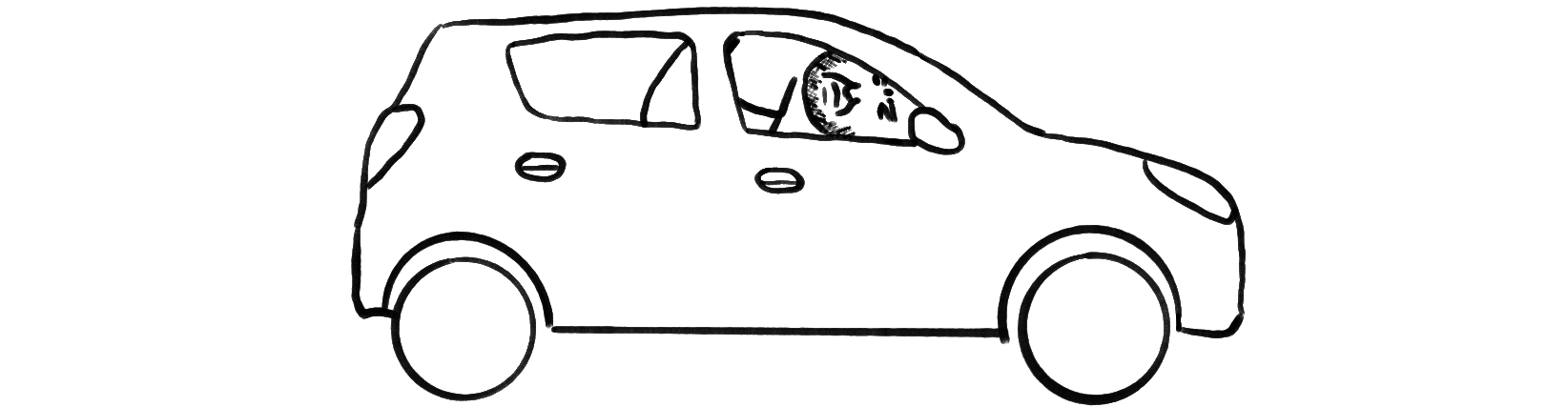
I sat in the front. After two months in Nepal, I still reflexively reach for a seatbelt that’s tucked away. Cab drivers invariably notice and reassure me that I don’t need one.2
As the driver snaked through the morning traffic, our guide Swoyam explained that we would make knives completely unlike the crap they sell to tourists. They would be forged, not machined. We would use stiff high-carbon steel, not more pliable metals. We would be making a tool, not a bauble.
The cab dropped us off at the bottom of a steep hill at the outskirts of Kathmandu. The driver deftly navigated the overloaded Alto around a last steep drop. It would have peeled the bottom clean off. The new government has earned a lot of praise for paving large swathes of Nepal’s road network, but at its edges, it remains a bumpy ride.
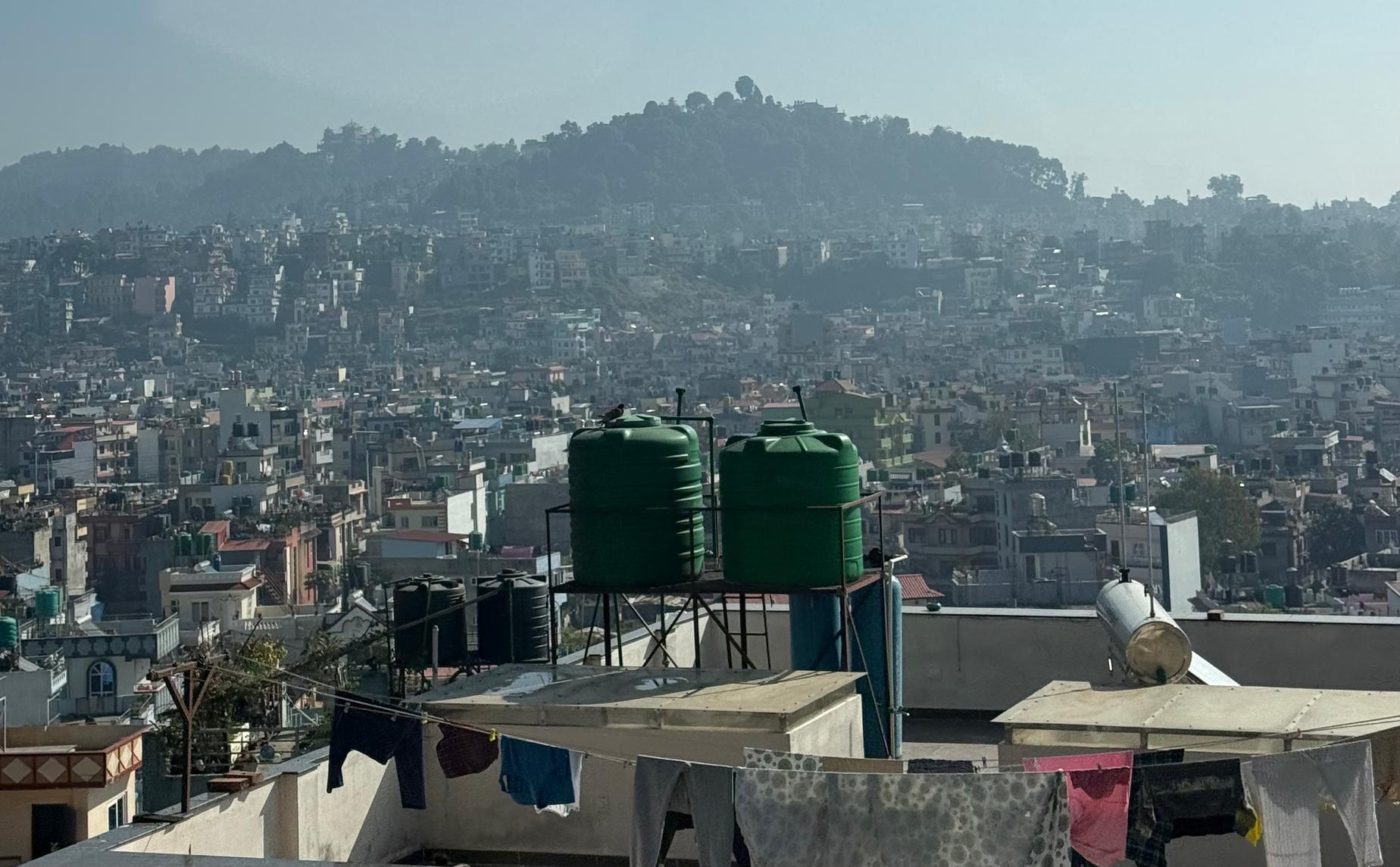
From there we could see Kathmandu sprawl into the haze.
Our blacksmith was waiting on the corner, squatting. He stood up and came to greet us. His name is Indra.
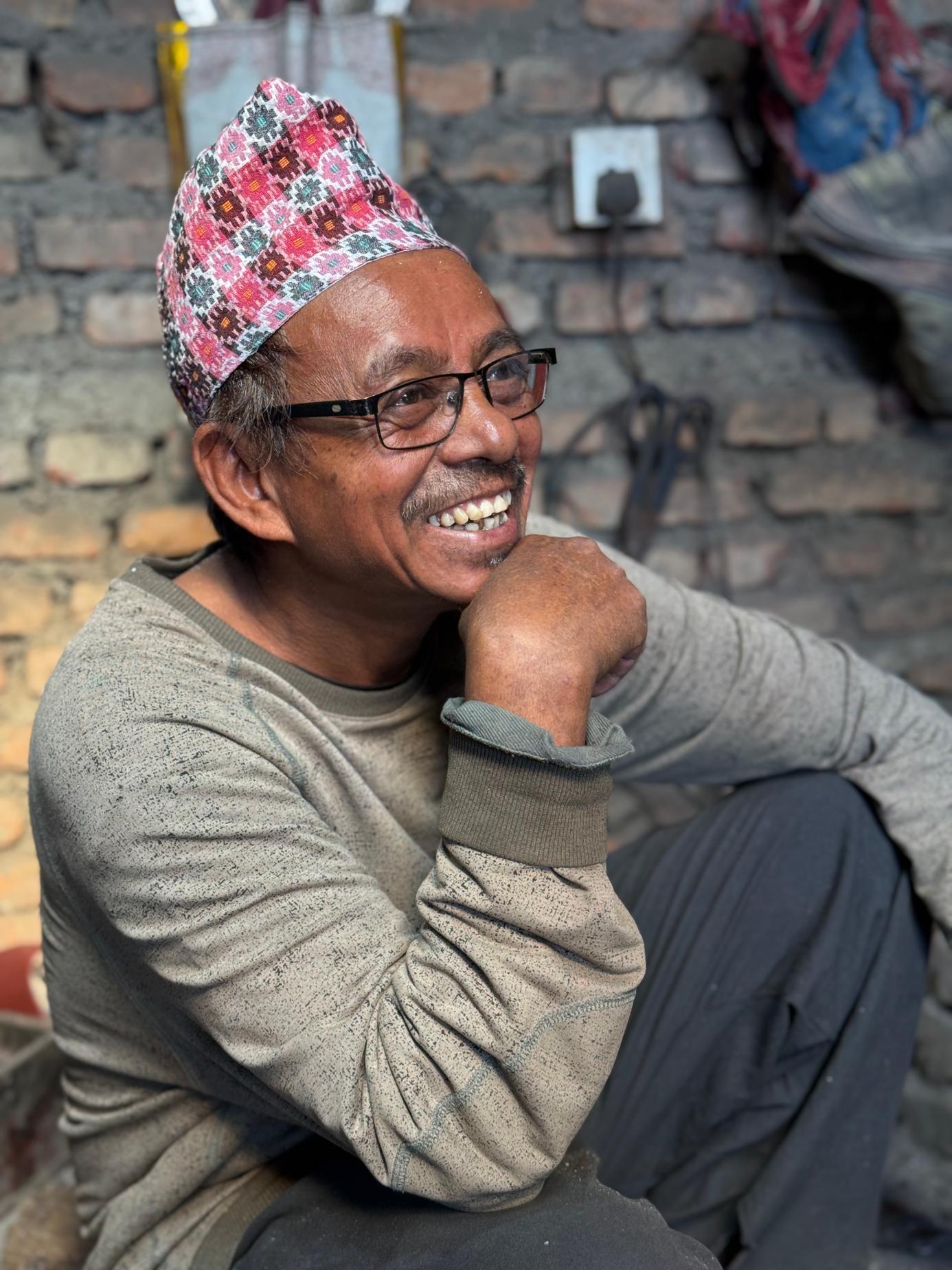
In the West, blacksmithing is the domain of disenchanted tech workers who seek solace in the tangible world. My guide explained that blacksmithing is the purview of our blacksmith’s caste. Thus it was not merely a hobby or even a profession, but an identity.
As industrialization relegates blacksmithing to knife making for the few and proud Gurkha, and for the many and undiscerning tourists, I wonder what happens to a caste when its role becomes obsolete. I asked around and found a few papers about it, but I lack the context to understand the answers I got.
Swoyam and Indra led us through their house and into a covered space that would hardly accommodate a rug. In the corner, there was a small forge about the size of a coffee table. Its bellows was an electric blower motor that stoked a small pile of charcoal.
Around the forge were a few mudha stools, hammers, an anvil and tools made in that very same forge.
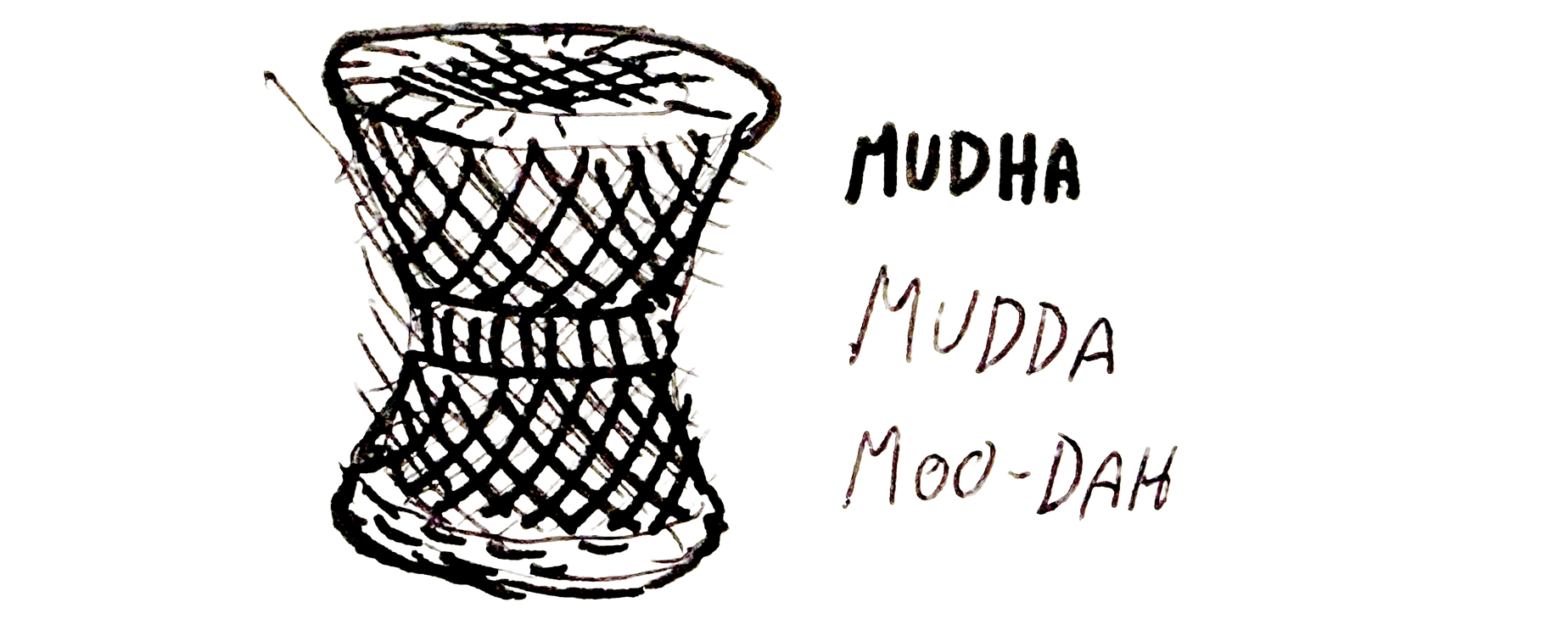
The blower motor hummed softly as it stoked the embers and filled the air with charcoal dust. Swoyam offered us masks.
We would make knives out of a car’s leaf springs. Spring steel is stiff stuff - unlike the mild metals they machine into knife-shaped decorations.3 Indra pulled the coiled end of a leaf spring from a junk pile and heated it to a deep red glow in the forge. He then pulled it out and flattened it with his hammer.
Louis and Indra split the piece of metal in half with a chisel. Each half would make one knife. It’s impressive that you can flatten and cut a quarter inch-thick steel plate so effortlessly using just hand tools. I can hardly open a bag of Haribo without my teeth.
Bit by bit, Indra hammered the lump of steel into a banana shape. At times he would invite us to deal it a few blows, then take over and correct our work.
The distinctive recurve of the kukri blade is intentional, unlike say the curve of Japanese blades.1 The blade is hammered into that shape because it’s helpful for chopping things. I have seen kukris hew lumber and crack coconuts. My guide added that the curve helps with slicing throats. Allegedly.
Indra returned the piece into the forge for a minute, then dealt it a few more blows. Each blow sent sparks flying. The sparks were impurities in the metal. They piled in flakes around the anvil.
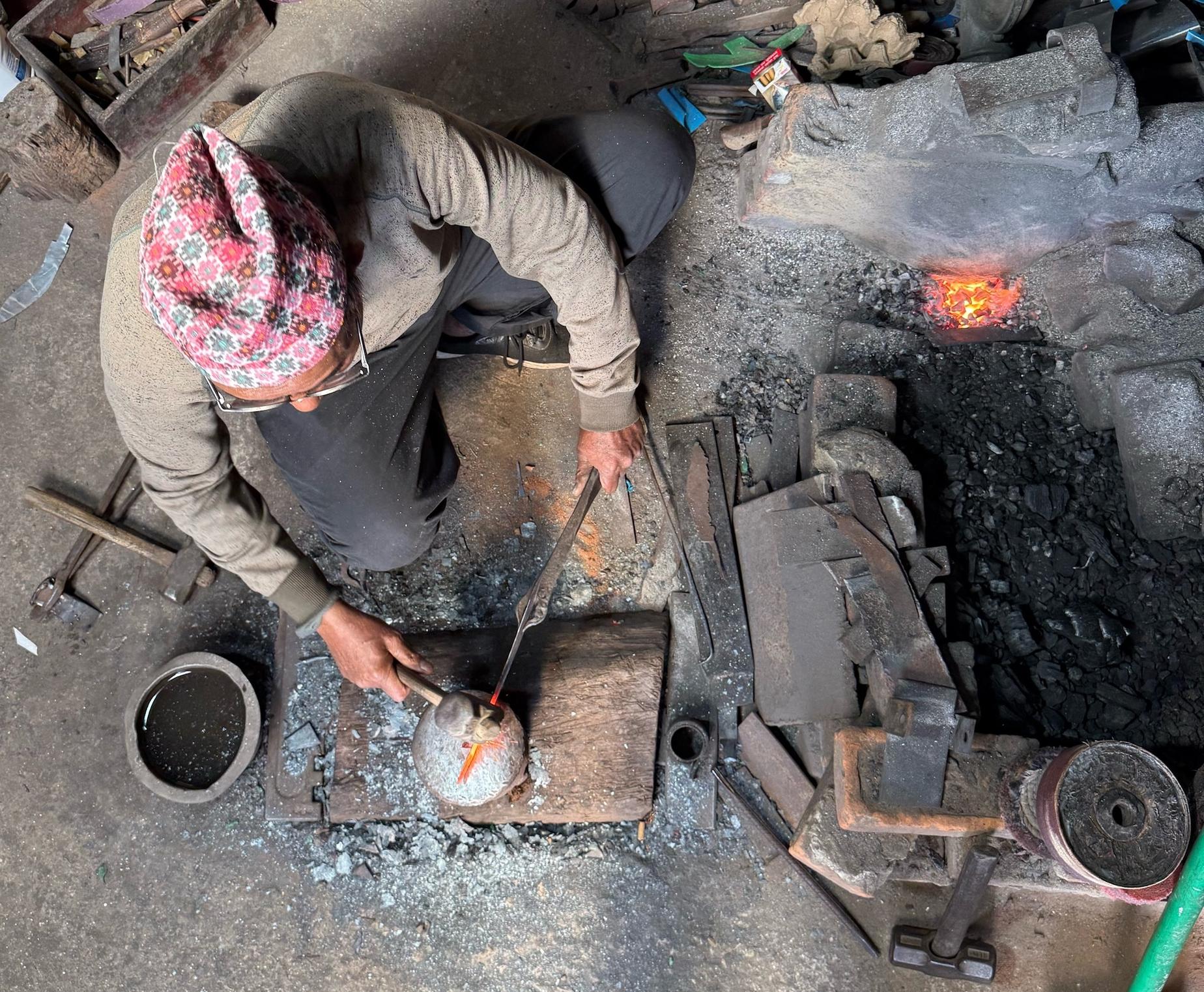
Indra shaped the blade using a sheet metal template. Each iteration brought the metal closer to something kukri-shaped.
Our contribution was rather pathetic. We gave the metal a few clumsy blows, then watched a professional hammer it back into shape. The effort was enough to feel the strain in our muscles and the shortness in our breath. Eventually, Indra abandoned all pretence of a team effort, and we mostly stood by and watched him do a proper job. Unlike us, he showed no sign of fatigue.
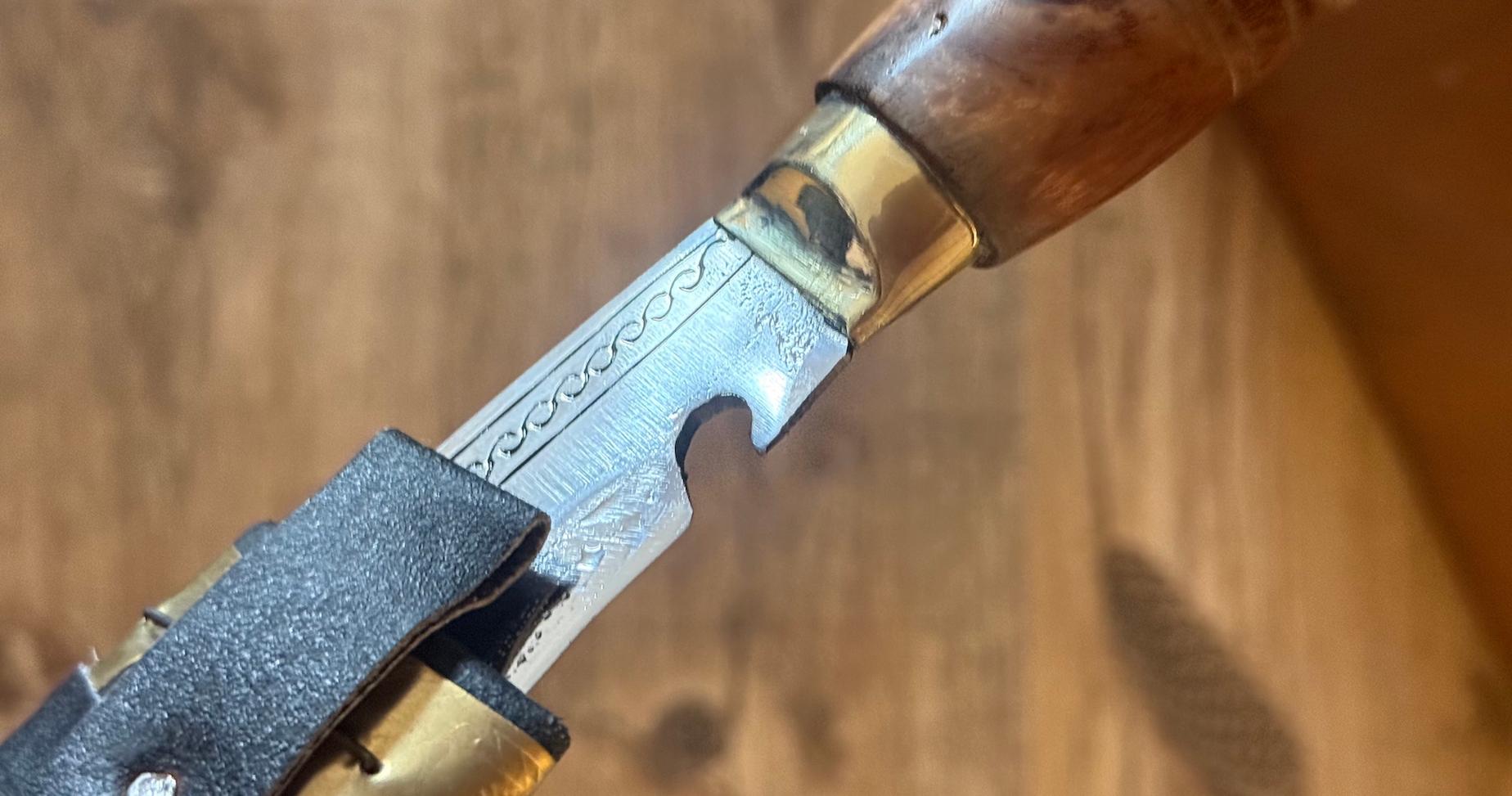
Kukris have an M-shaped notch called a karda near the handle. It has many reputed purposes, but the fan-favourite is that it makes blood drip off instead of running onto the handle. It also represents the Himalayas or Shiva, depending on whom you ask.5
We made the notch by hammering a length of shaped rebar into the edge.
Two months in Nepal gave me a skill that I hope to bring home: the ability to ask for things that are not listed on the menu. I have no use for a decorative knife, and little use for a kukri. I neither split coconuts nor slice throats. I sheepishly asked if instead of a culturally-significant notch, I could get my notch in this shape:

Because this is Nepal, and not the famously stiff and inflexible culture where this shape is relevant, that was not a problem. The guide and the blacksmith exchanged a few words, the blacksmith nodded, and that was it.
On the non-pointy end of the knife is a long, thin metal section, the tang. This part is inserted into the handle. Swoyam pointed out that our knives had a full-length tang, again in contrast to decorative kukris.
Forging the tang required a sledgehammer and the strength of a younger blacksmith named Prakash.
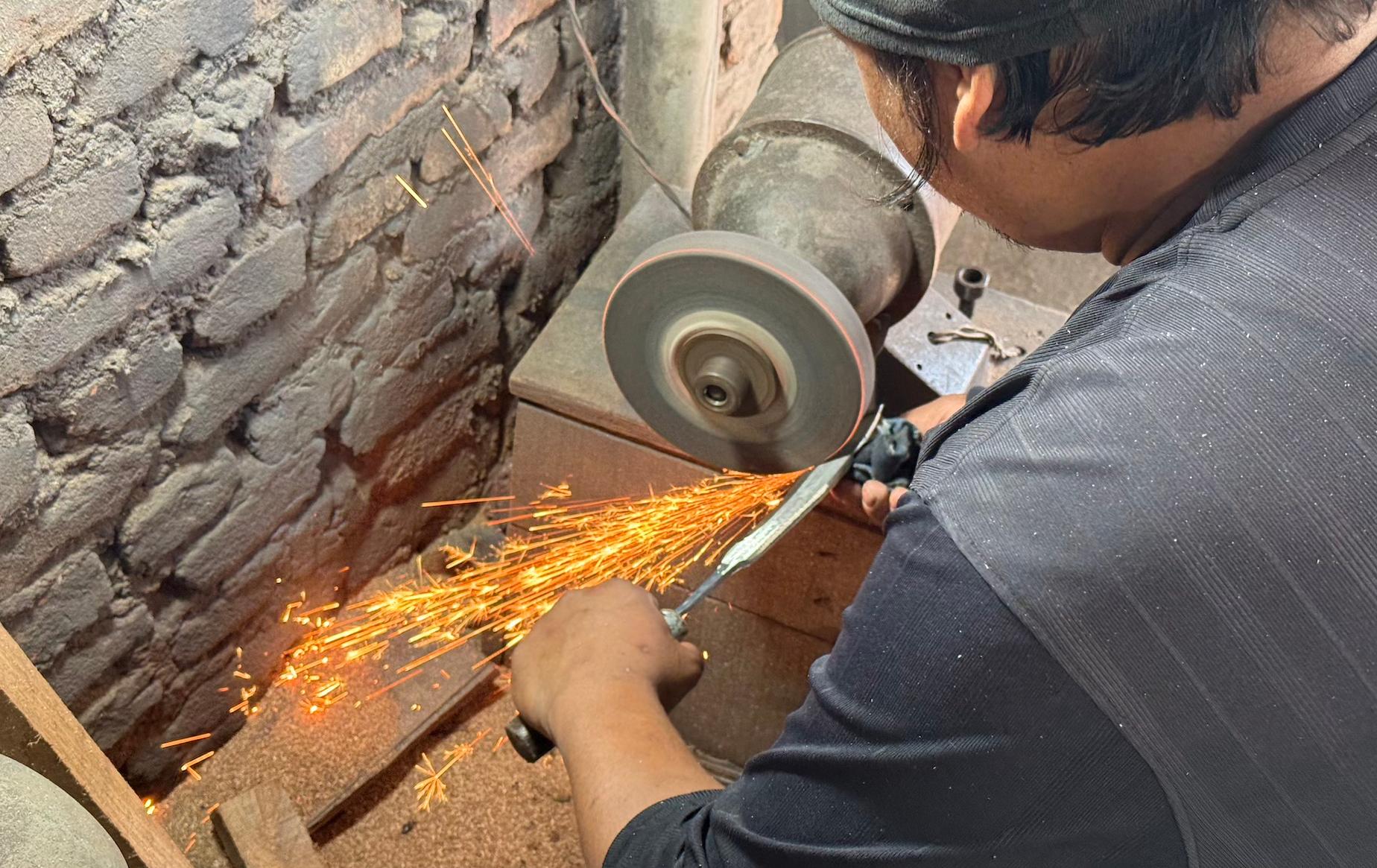
Using a wheel grinder, we smoothed out the surface of the knife. Wheel grinders are terrifying. Against my better judgment, I chose to wear gloves, which is a big no-no around rotary tools. Sparks flew and the knife bounced on the wheel far more than I expected.
Mercifully, once I had removed most of the rough surface, Prakash stepped in to finish the job properly. He refined the shape of the spine and removed grind marks. He seemed unfazed by the glowing bits of metal flying at his eyes.
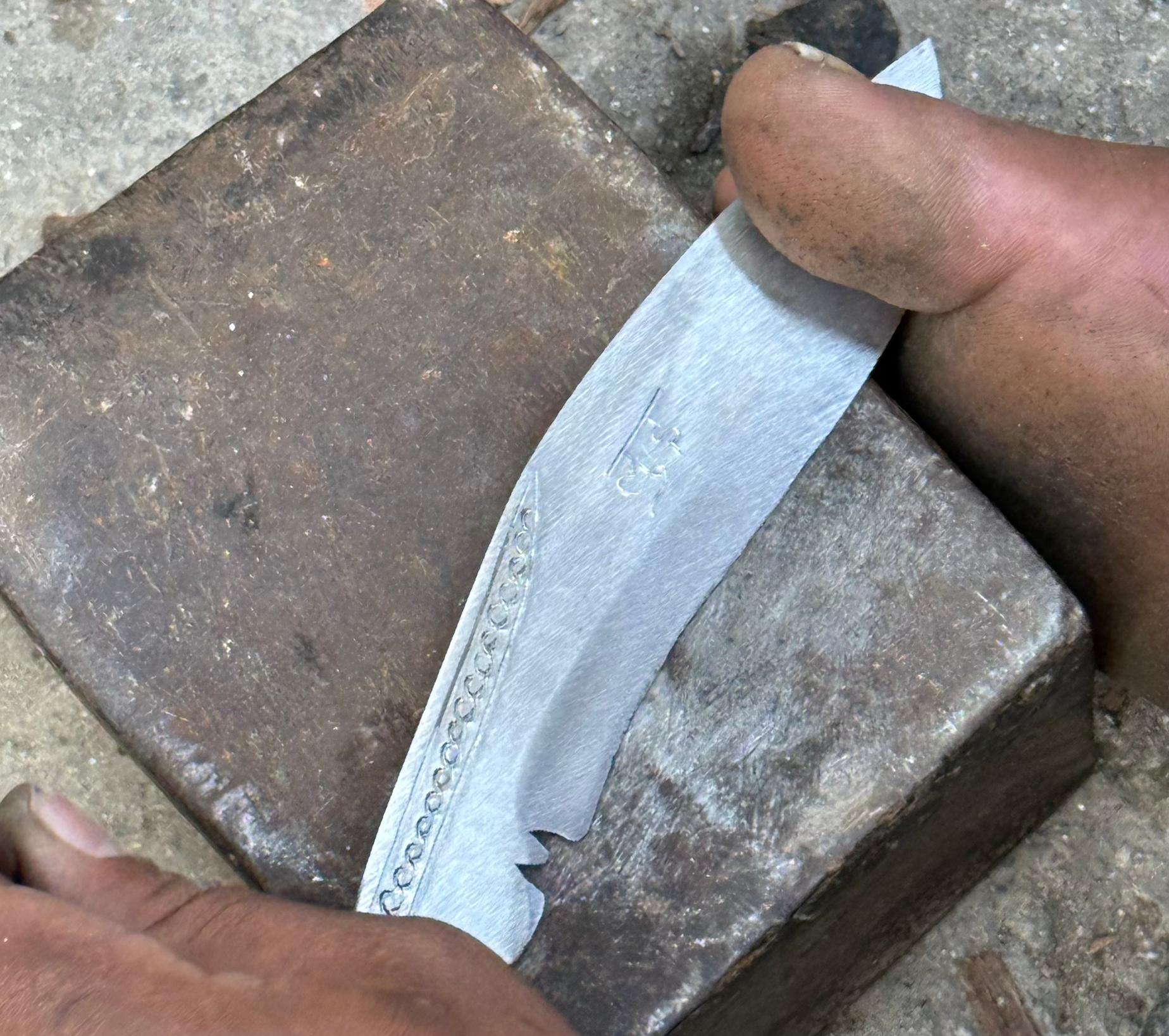
Then we took the knives outside to engrave them. Prakash secured the blade between his toes and chiselled a pattern into the blade. He offered us to engrave anything we want. Short on wit, I left mine unmarked. I did not want to commit the engraving equivalent of meaningless Chinese tattoos.
I also feared that a personal engraving would affect the knife’s resale value, as if I was choosing which emojis to engrave on my AirPods. Preposterous, I know.
Louis had his Nepali name engraved.4
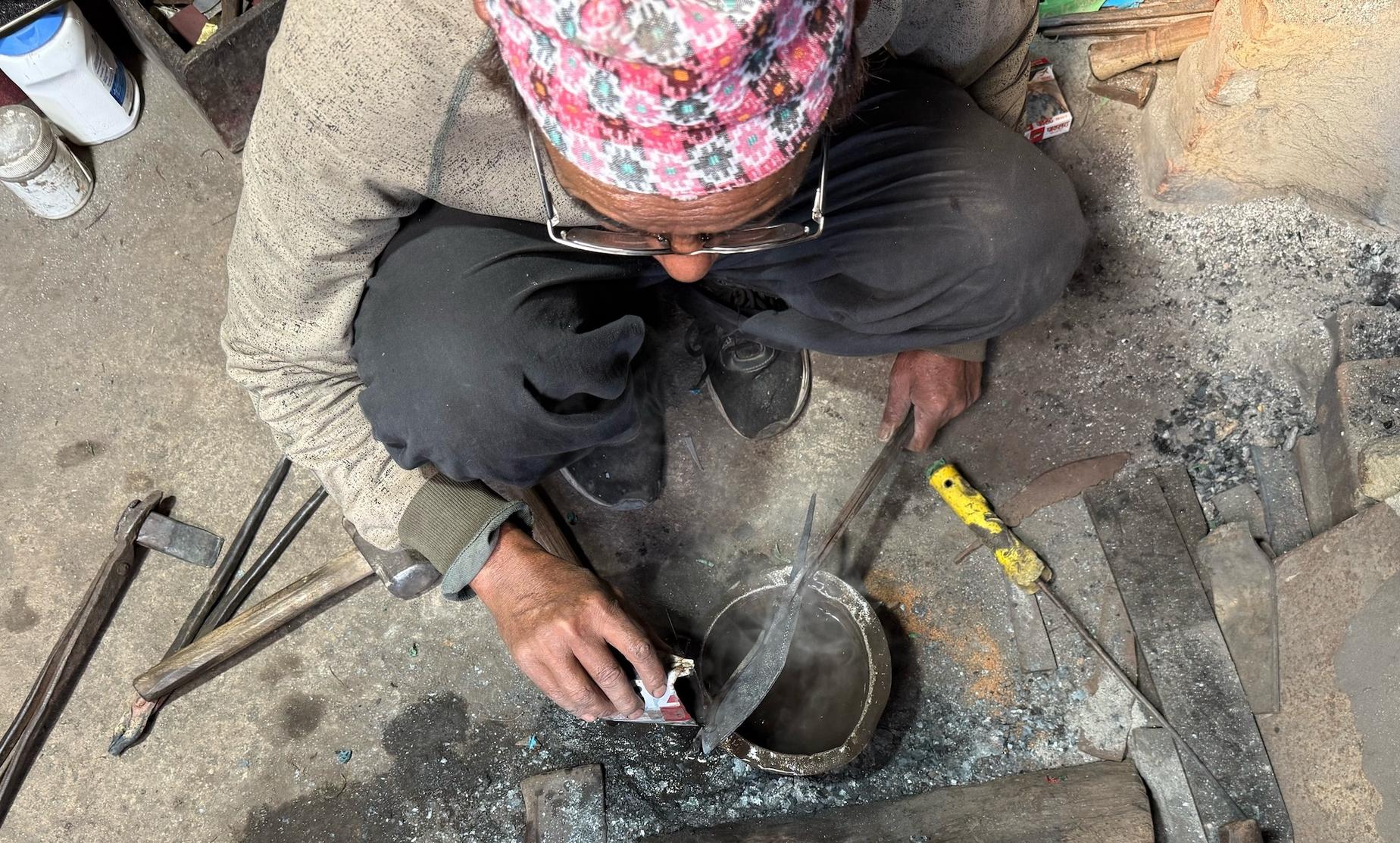
Indra quenched the blade’s edge to temper it. Tempering makes the metal harder but more brittle. The blade holds its edge better but chips more easily.
We went back inside to fit the handle onto the blade. The handles were hand-carved in advance out of rosewood. Unlike most Western knives where the handle is two pieces of wood that sandwich the blade, this one fits around it like a sleeve, a bit like my santoku knife.
More grinding helped achieve a better fit, but in the end, the gaps are filled by melting plastic into the hole, like the ketchup in a gas station hot dog. The plastic then hardens and the blade does not wobble inside the handle. Traditionally, this was done with tree resin, but plastic is cheaper, readily available, and just as effective.
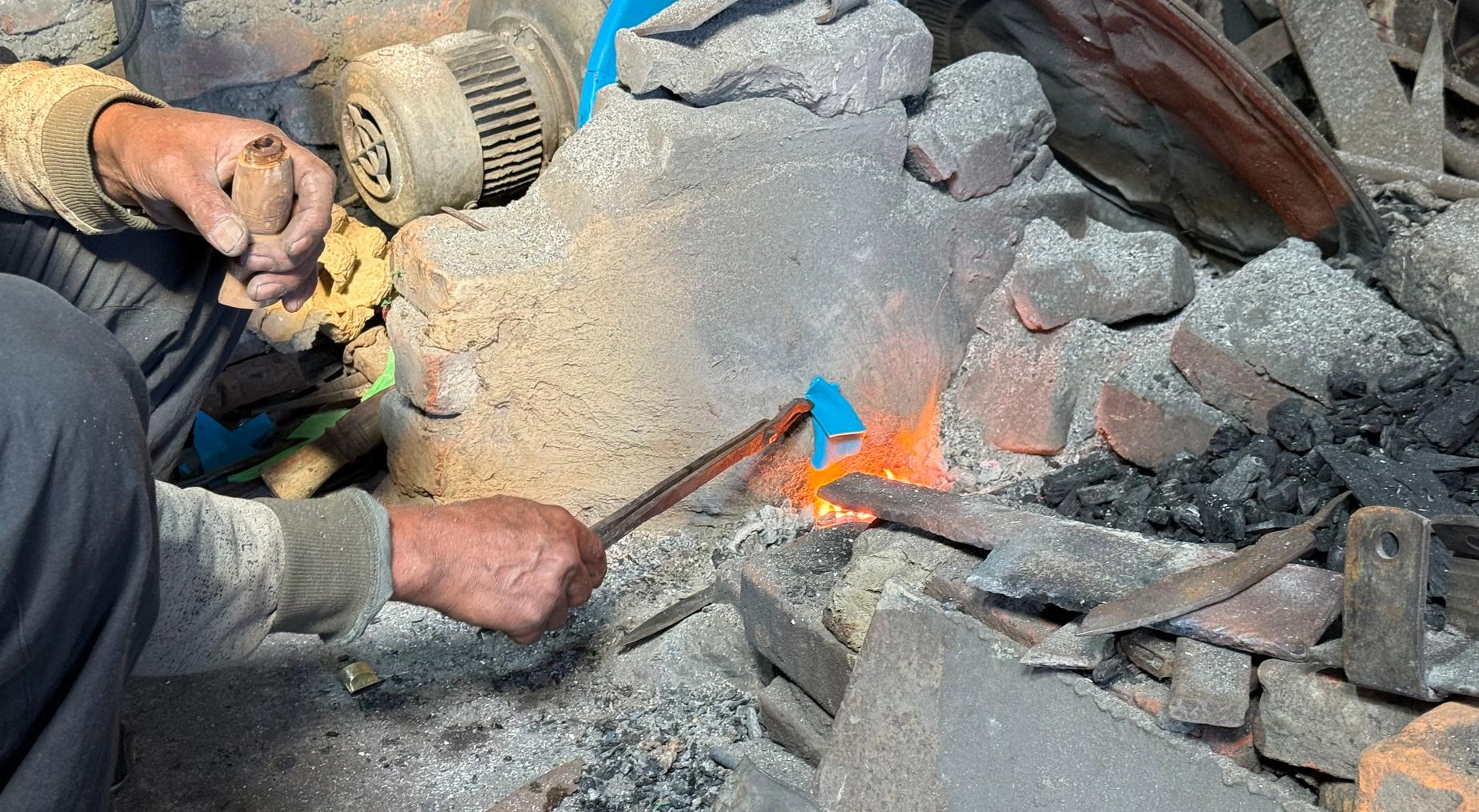
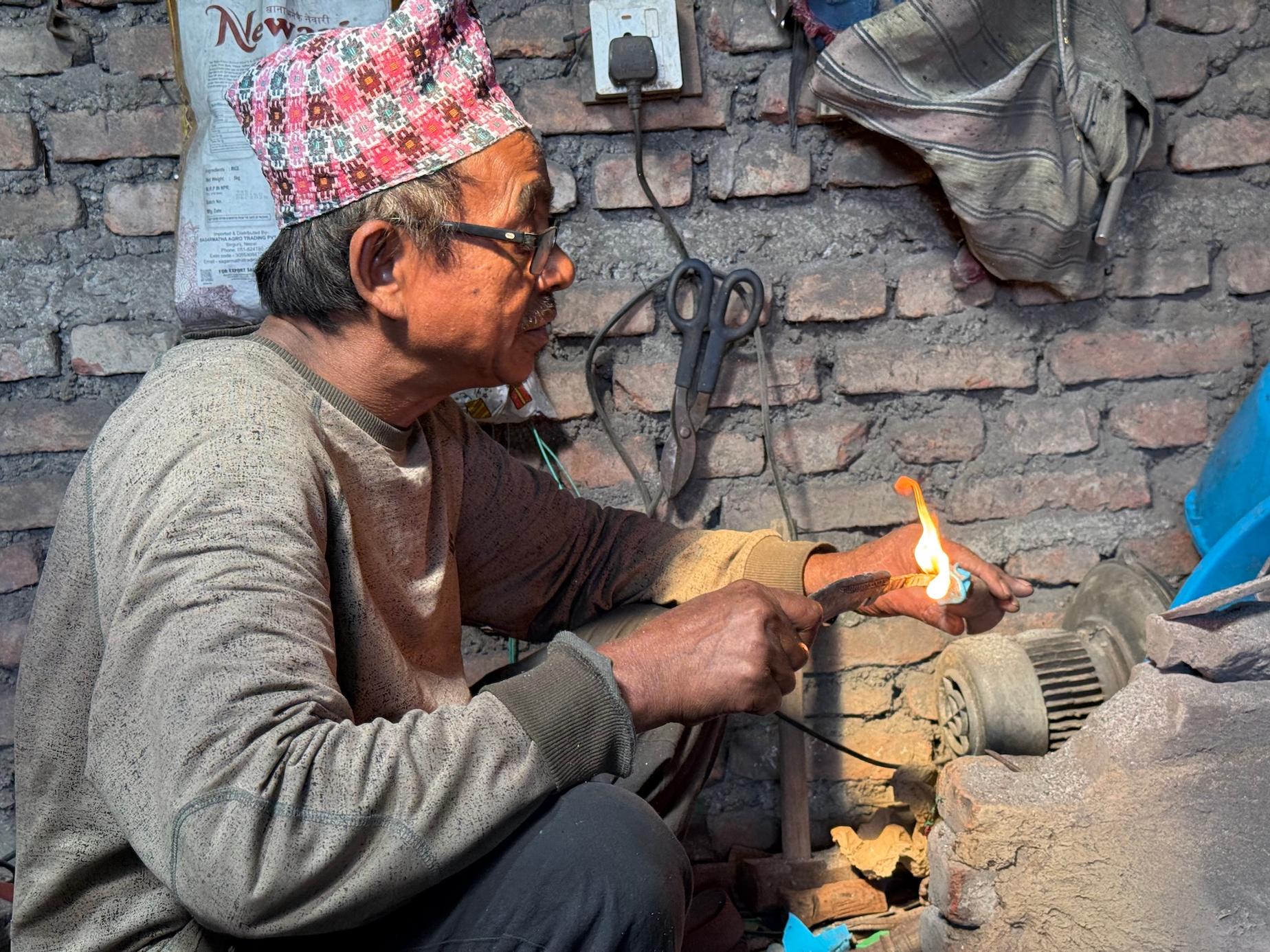
The blade is held into place by hammering the end of the tang like a rivet while it’s still hot. A small brass square acts as a washer. As the blade cools down, the metal contracts and tighten the fit.
At this point, we held something a lot more knife-looking. The next step was to polish and sharpen the blade using a much finer grinder wheel. Prakash tested the sharpness of the blade by cutting through a playing card. When he was satisfied, he demonstrated his work by effortlessly shaving a bit of Louis’ arm. I refused the same demonstration as I don’t grow arm hair so effortlessly.
If I could grow a beard, I could have had the manliest shave ever. Knowing myself, I’d probably have sliced my own throat as effortlessly as if it was a playing card.
Carbon steel blades rust, so they must be oiled. Prakash rubbed the blades with vegetable oil, then oiled the handles with a different material. He put each knife in sheaths. Those were also made in advance.
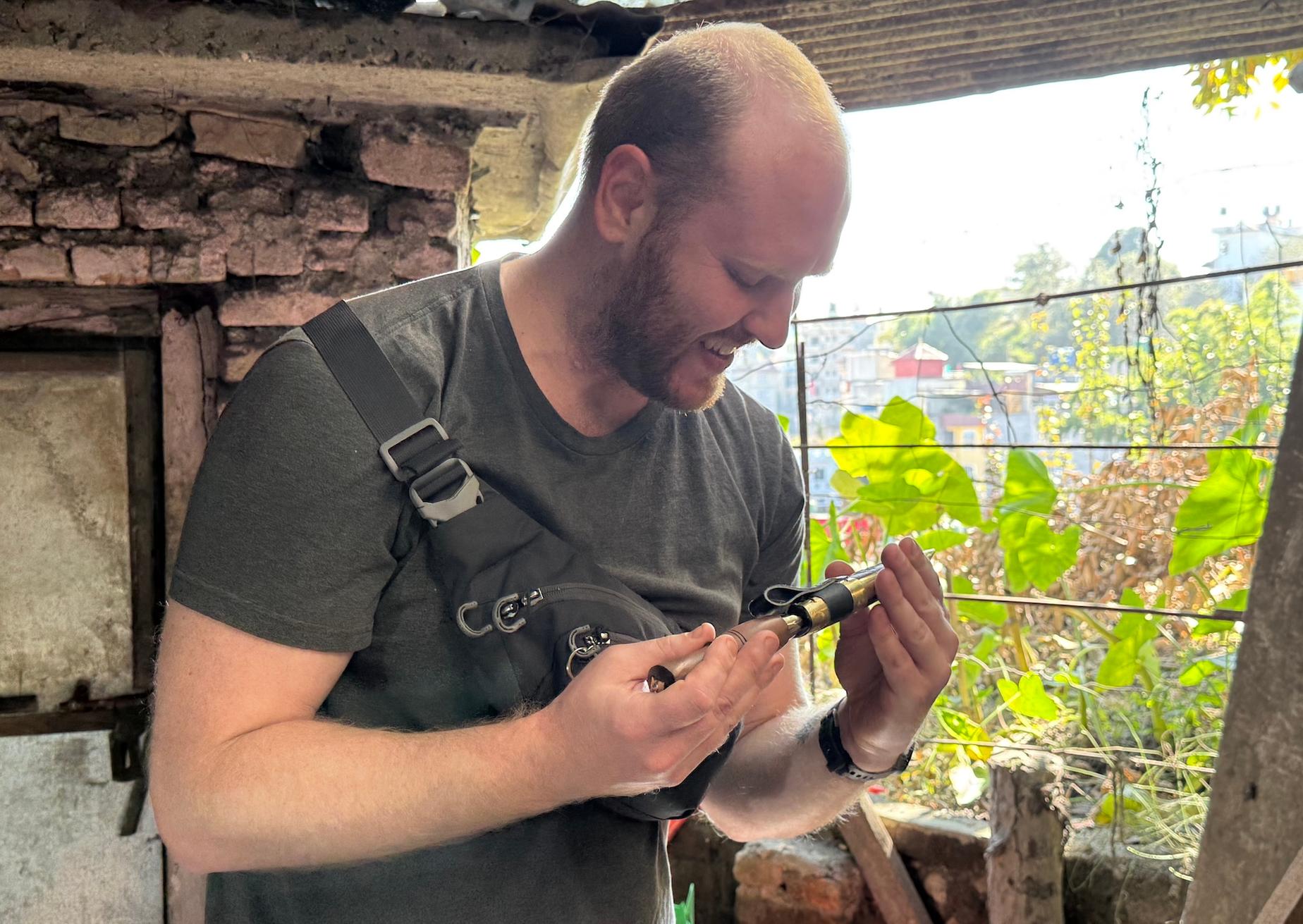
My kukri is unique in its own way. If I went through the trouble of taking a knife onto 3 different flights over 2 months, I wanted it to be more than a decoration.
I have eschewed tours, guides and tourist experiences for most of my life. I always roughed it out on my own, thinking that I was Not Like The Other Tourists. Anything that challenged that status was best avoided.
Dear reader, I was wrong. Tourist stuff is great. I love massages, food tours, and spectacle of any kind. In this instance, I loved having someone patiently answer all of my questions and fill my head with trivia. It’s a rare pleasure to have your curiosity instantly rewarded.
Book such experiences directly when you can. When you book through TripAdvisor, GetYourGuide or AirBnB, the platform keeps around 30% of the booking fee. This class was organized by I Experience Nepal. You can book it on their website.
Sources and footnotes
-
Unlike Japanese blades that get their curve from the edge and the spine cooling at different speeds. The edge is quenched, making it hard but brittle. The spine is cooled slowly, making it soft but flexible. The cooling speed is controlled by coating the blade in clay: thickly on the spine, thinly on the edge. ⤴
-
I do not agree. To wit, I am five times more likely to die a traffic-related death in Nepal than in Germany, so I hedge against those odds however I can. ⤴
-
Yes, I feel quite smug about it. The smugness is part of the experience you pay for. ⤴
-
Correctly, as it turned out. ⤴
-
The relevant section of the Wikipedia articles has a lot of [citation needed] and [original research?] marks, which is wikipedian for “could be bullshit, who knows”. ⤴